Annie Sloan
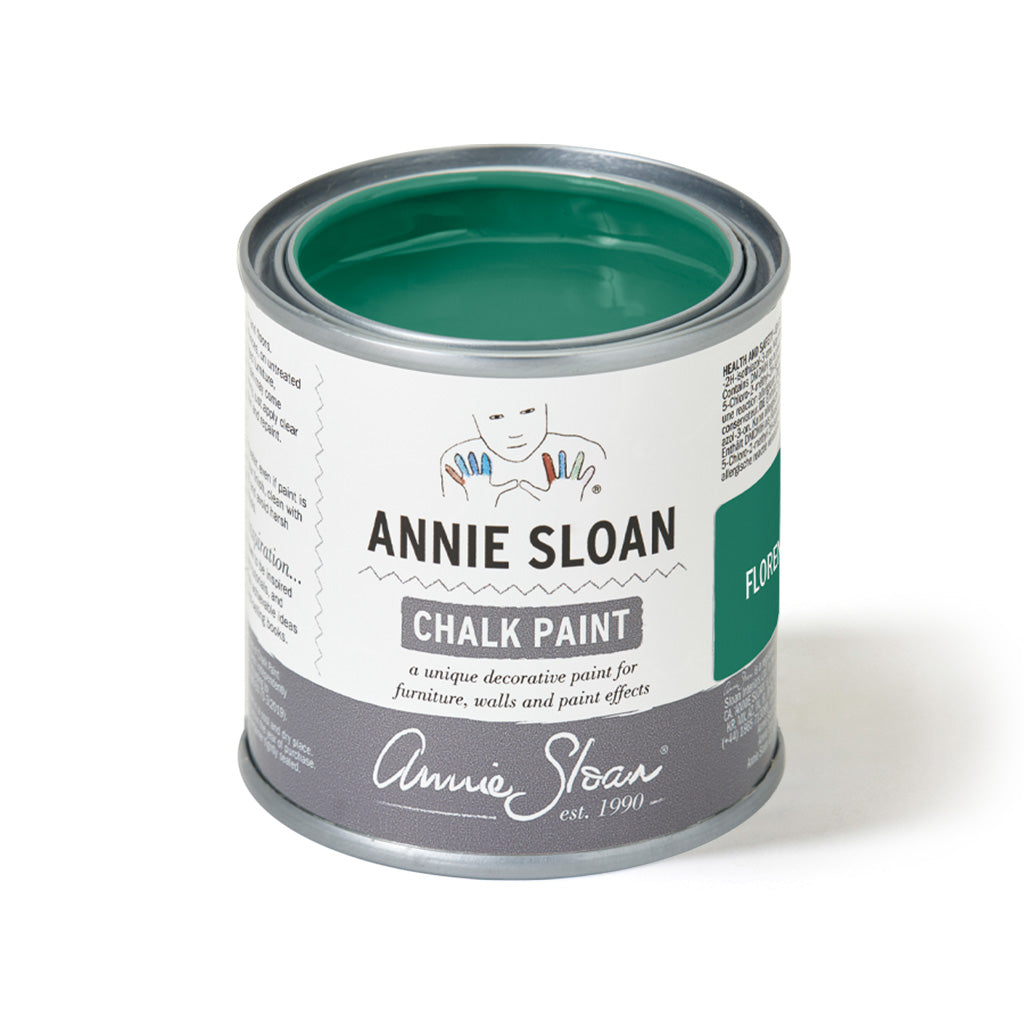
Florence Annie Sloan Chalk Paint®
Florence Annie Sloan Chalk Paint®
Couldn't load pickup availability
Florence in Your Space
Florence is one of the most intensely beautiful colours in the entire Annie Sloan range — a deep, jewel-bright teal that carries within it the richness of Renaissance pigments and the particular quality of light that falls on old Italian cities in the late afternoon. It is a colour of real presence and gathered, living depth, a blue-green that has arrived at something completely resolved and completely its own.
This is not a colour that sits quietly. Florence transforms a piece the moment it is applied — giving it a quality of considered, accumulated beauty and quiet, gathered authority that makes it the natural centre of any room it inhabits. Use it on a single statement piece and it will hold the space with complete conviction.
Colour Companions
Light & Open
- Pure — bright and completely open, alongside Florence it creates a combination of real freshness and considered, luminous contrast
- Paris Grey — cool and quietly considered, it gives Florence a softness and a quality of gathered, open sophistication
Tonal Blues
- Louis Blue — warm and quietly refined, alongside Florence it builds a palette of real considered ease and gathered, tonal beauty
- Aubusson Blue — deep and richly gathered, alongside Florence it creates a tonal palette of real complexity and accumulated, layered depth
Finishing Touches
- Clear Wax — preserves the full jewel-bright depth of Florence exactly as it is
- Dark Wax — deepens Florence into something richer and more atmospheric, adding a beautiful sense of age and gathered character
How to Apply
Florence covers beautifully in two coats, its jewel-bright depth building with each layer into a finish of real, considered beauty. Its intensity deepens as it dries — always let each coat dry fully before assessing coverage.
The Chalk Paint® Difference
Annie Sloan invented Chalk Paint® in 1990 and it changed furniture painting forever. The formula is water-based, ultra-low VOC (2.2g/l), and virtually odour-free — and it bonds to almost any surface without the stripping, sanding, or priming that traditional paints demand. One tin, one brush, and you're ready to go.
It works on timber, metal, concrete, brick, laminate, and plastic. Indoors or out. Smooth and matte or heavily textured. The finish is entirely yours to decide.
Before You Begin
Give your tin a good stir — no shaking needed. Load your brush and work in smooth, even strokes. One coat often surprises you with how much it covers; a second coat gives you full, solid opacity. Always let each coat dry completely before continuing.
Making It Your Own
- Build up thick layers for a sculptural, impasto effect, then seal with wax
- Sand back lightly once dry to reveal what's underneath and create genuine, earned wear
- Add a little water to thin the paint into a translucent wash that lets the wood grain breathe through
- Blend colours directly on the piece — Chalk Paint® mixes beautifully for completely custom results
Sealing & Protection
Annie Sloan Clear Wax is the classic finish — it protects and adds a subtle, natural sheen. Dark Wax settles into mouldings and edges for depth and shadow. For outdoor pieces or high-traffic surfaces, Annie Sloan Lacquer gives a harder, weather-resistant finish.
A Few Questions We Hear Often
Will it work outside?
Yes — seal it with Annie Sloan Lacquer and it will handle the elements beautifully.
Does it have to be sealed?
Not always. Decorative pieces that won't see daily wear can be left as they are. For anything that gets touched, wiped, or sat on regularly, wax or lacquer will protect your work.
Can I mix my own colours?
Absolutely — it's one of the great joys of Chalk Paint®. Mix directly in the tin or on the piece itself.
Which brush should I use?
Annie Sloan's Flat Brush gives a smooth, even finish. Her Round Brush is ideal for working paint into carved details and creating texture.
How much do I need?
One litre covers approximately 13 square metres. The 120ml size is perfect for smaller pieces, testing colours, and mixing experiments.
Share